@east-coast-jazzmen
- Followers 0
- Following 0
- Updates 2
The East Coast Jazzmen - From the Beginning
A Brief History of the first 62 years of The East Coast Jazzmen By Ron Elder
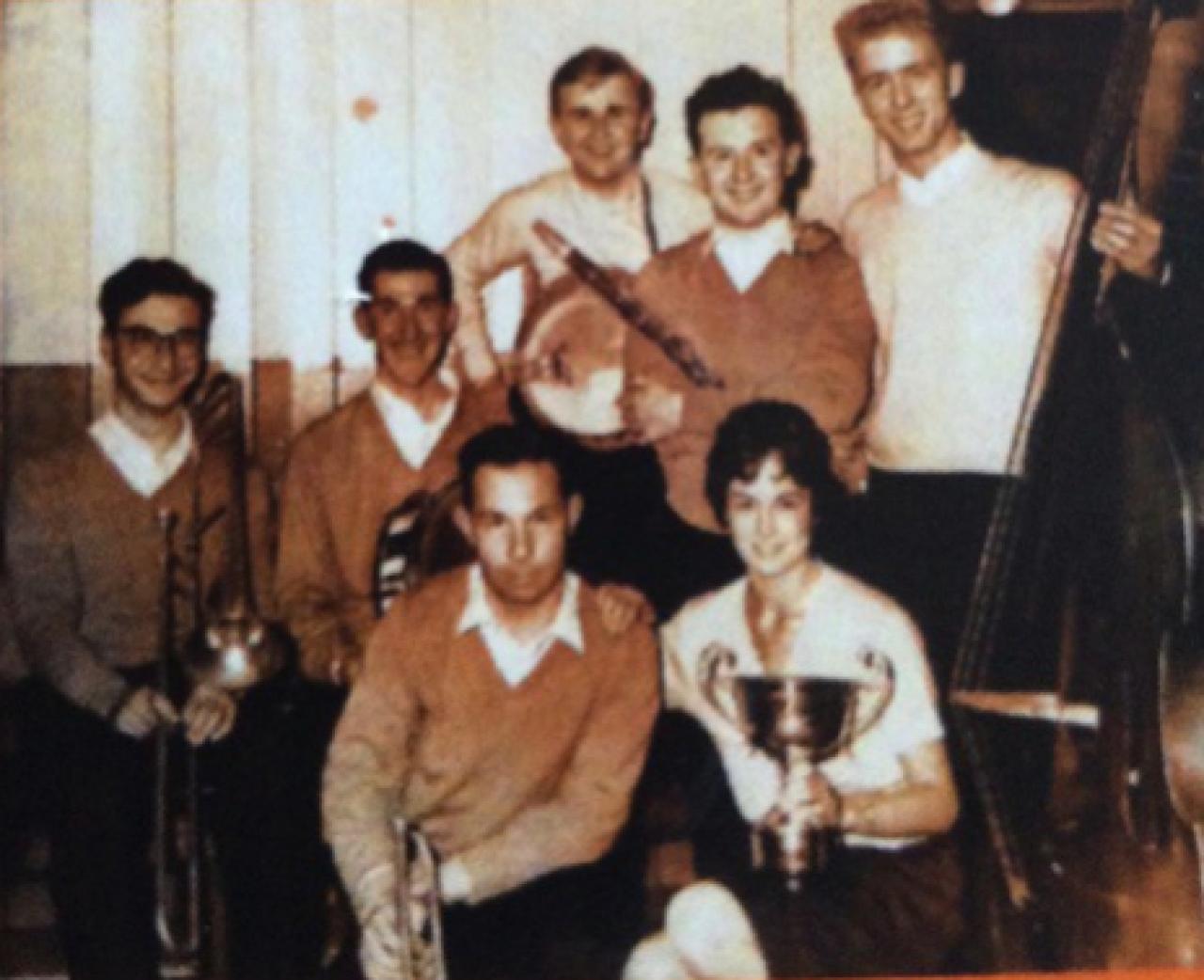
In March 1958 in the Palais Ballroom in Tay Street, Dundee, young Andy Lothian brought together a group of musicians from the Dundee Jazz scene to form the East Coast Jazzmen. They were all around 18 years old and were drawn from a number of bands that played around the city in varying combinations.
Andy brought some order and purpose to the seven musicians and after rehearsal soon had them sounding quite professional. The standard traditional tunes such as Creole Love Call quickly became the repertoire of the newly formed band. The line up and the tunes reflected the sound and line up of the traditional bands such as Barber, Bilke and Ball that were popular throughout the country at the time. Bass, drums, piano and banjo provided the rhythm for the Clarinet, Trumpet and Trombone front line. Musically, the system was incredibly simple in that the trumpet played the melodic lead with the trombone providing a sympathetic bass line leaving the clarinet free to add embellishments. Thus armed with a selection of tunes and a game plan to attack any new tune, the Band set out to make its fortune.
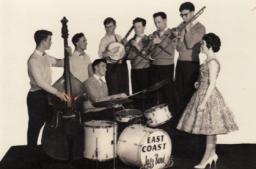
Walter Fisher (trombone) Harry Morrison (Drums) Watson Laing (Banjo) Andy Tully (Clarinet) Andy Lothian (Bass) Dave Fimister (Trumpet)
Les Cameron (Piano) Bonnie Lee (Vocal)
On Sunday nights the band played at the Parker Street Jazz Club. This was a small windowless dive that was the dance school of Tommy Glennan, the Manager of the Locarno, a few yards from Parker Street. Parker Street was filled every Sunday night with jazz fans who listened and danced to the band with perspiration running down the walls and their foreheads. It was a crowded and happy place. The more the band played the better they got as they adjusted to playing the tunes together. They were young: they listened and they learned. Sheila Mitchell joined the Band as a singer making the payroll up to eight.
The Band playing at Parker Street Jazz Club
Andy Lothian had ambitions for the band to be a force in the country. He organised gigs for the band and acquired a van to take them around to far-flung places. Geography played little part in the booking process as the band played in Woking, Surrey, one night and Dingwall in the Highlands, the next. Life on the road was uncomfortable but all the band were young and carefree so it was a laugh - for a time.
In 1960 the East Coast Jazzmen entered the Scottish Jazz Band Championships held each year in St Andrews Hall in Glasgow. Les was not with the band as he was recovering from a footballing injury. The van, of course, broke down on the way to Glasgow, meaning that they did not arrive until well through the proceedings. After lengthy negotiations they were allowed on last.
The audience had expected the George Penman band to win the title. They were a very good band from Glasgow with a strong following in the West of Scotland. There was uproar in the hall when the East Coast Jazzmen were declared the winners. There is little doubt that the rendition of “The Piper of Dundee “was the factor that won them the competition. This had been suggested and arranged by Andy Lothian senior, the leader of the Palais Dance Band. It was a clever arrangement, played in the key of G, to mimic the sound of bagpipes in the introduction. It had originality and displayed the musicality of the band.

The East Coast Jazzmen win the Scottish Jazz Championships
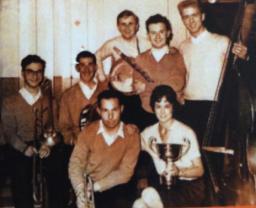
With this title on their CV the band went from strength to strength in touring gigs. Andy, the leader, was an entrepreneur with an eye to anything that helped their fame and income. Dick McTaggart, the Dundee lightweight boxer was at the peak of his powers and fame at the time. He had won the Commomwealth medal and held British and world titles at his weight. Andy decided that Dick could appear with the band as a singer. Sadly Dick could hit anything that moved except a note, so his singing career ended abruptly. However, undeterred, Andy had him attend gigs with his medals to show to the crowd. This worked well for a time and created some interest until the gig at the Reid Hall in Forfar. There the audience, made up of country chiels and oaramen, decided the Dick didn’t look too tough for them and climbed onto the stage to exchange haymakers with him. He had to be spirited away out the back door to safety. Another bright idea fizzled out.
Lets sort out the Name
In 1959 Sheila Mitchell, who later became Mrs Lothian, replaced Bonnie Lee (below) as the vocalist in the band. This led to a name change to The East Coast Jazz Band as can be seen on Harry’s drum kit below. Les Cameron was on piano and accordion. This meant that the band had to rely on, usually upright, pianos in the halls that they played in. The chances of finding one in tune were quite small. However, this was life on the road. Les added to the band in that they could play a greater variety of tunes, including Scottish country dances. This was the beginning of the East Coast Jazzmen broadening its repertoire of songs and dances. This was a quite different path from the traditional Glasgow jazz band which tended to stick to a purist New Orleans song book.
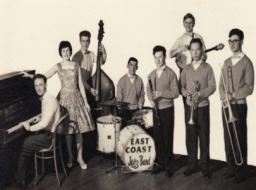
The “ trad” boom was still going strong and the Glasgow win had the effect of alerting many musicians to the talents of the band. When Jim McHarg left the Clyde Valley Stompers to form his “West Coast Stompers” taking Malky Higgins, the trumpet player with him, he raided The east Coast Jazzmen for Andy Tully on Clarinet and Dave Moodie on banjo. At this time various disrupters were appearing for the band in the shape of National Service, careers, and studies.
Most significantly Andy Lothian decided that his financial future lay in being a promoter rather than a gigging musician. He set up his Lothian Agency and began to hire and sign up many pop bands. This included signing up The Beatles to do a tour of Scotland, including playing at the Caird Hall. His timing was good, as the Beatles became a national phenomenon just after he signed then to the tour. Andy went on to establish an international business empire called Insights which still flourishes to this day. Thus in the Early 60’s The East Coast Jazzmen dissolved and disappeared from the scene.
The Fallow Years 1960 – 1964
The members of the East Coast Jazzmen took jobs all over the country. Some remained in Dundee and continued to play in a variety of different bands. The jazz scene continued in halls all over town but never quite achieved the atmosphere of Parker Street.
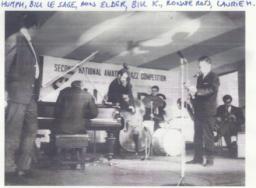
Humphrey Littleton - Bill Le Sage -Ron Elder -Bill Kemp - Ronnie Ross - Laurie Hamilton

In 1962 I arrived in Dundee as a student and started playing in bands of all shapes and sizes around the City. Interestingly one of these bands, the Laurie Hamilton Quartet, played and won the Scottish Jazz Band competition in Edinburgh and earned a spot playing at the Richmond Jazz Festival in London in 1964 with Humphrey Lyttleton, Ronnie Ross and Bill Le Sage. We won the Championship again in 1965 and featured at the Scottish Jazz Festival at Dam Park in Ayr. I also joined the Chalet Band. This was a six- piece dance band that played in The Chalet in Broughty Ferry on Friday and Saturday nights each week.
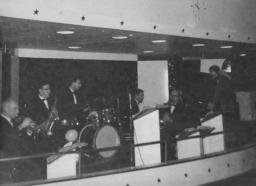
The Chalet Band 1967
Eric Soutar, Bob Bruce, Don Smith, Iain Mathieson, Jimmy Doig, Ron Elder
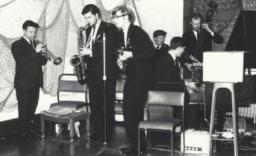
The Fulltone 4 + 2 in 1963 Dave Fimister & Molly Duncan join the regular Fulltone 4 Graham Nairn, Laurie Palmer, Ron Elder & Cambell McPhee.
Dave Fimister and I were students together and Les Cameron came down from Nairn to be an environmental health officer, with Dundee City Council, and the reserve goalkeeper with the excellent Dundee Football Club, which was in its prime at that time. Les was a piano and accordion player and took a job playing at the Invercarse Hotel accompanying Jill Gascoine, the actress, from Dundee Rep. Jill, who died in Los Angeles in April 2020, provides an interesting subsidiary story with the band.
Jill was a member of the Rep Company in the early 60s. She went on to marry Bill Keith, the Manager of the Invercarse and then owner of the Greystane Hotel. She organised Poetry and Jazz evenings at the Rep in Nicoll Street. I played one of these on Sunday the 2nd of June, 1963 with Gerry Culley on piano and Don Smith on drums. What makes the evening memorable was not the somewhat pretentious performance but the fact that we woke up on the Monday morning to find that the Rep had burned to the ground.
The East Coast Jazzmen Reformed
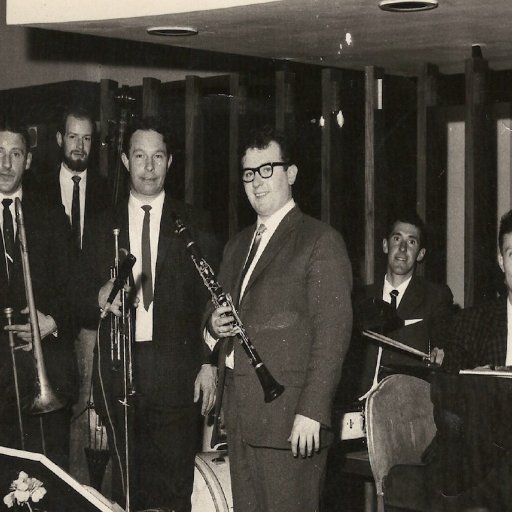
Les Cameron decided to reform the East Coast Jazzmen and went about resurrecting the old crew and where necessary, inviting in new members. Thus Dave Fimister was on Trumpet, Andy Tully on Clarinet, Harry Morrison on Drums and Dave Moodie on Banjo. Jimmy Wallace was recruited on trombone. Jimmy had long been recognised as the best traditional trombone player in Dundee but had been in Germany with Dr Crock and his Crackpots when the band was first put together in 1958. I was asked to join on Bass and the band was complete. The title of the band was The East Coast Jazzmen and this has continued up to the present.
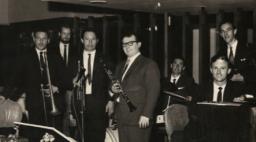
The East Coast Jazzmen in 1965
Jimmy Wallace, Ron Elder, Dave Fimister, Andy Tully, Harry Morrison, Les Cameron, Dave Moodie
We had a permanent booking for a supper dance at the Invercarse Hotel on Sunday nights. This ran from 1964 until around 1980. Just as the Parker Street Jazz Club had been the base for the early band, the Invercarse proved to be just as important to the reformed East Coast Jazzmen. The Band played weddings, dances, Bar Mitzvahs, Provost’s Balls and accompanied vising guests such as Kenny Ball and others at the Caird Hall. Most of the band had secure full time jobs by this time so gigs were restricted to accessible places. No van transport was used and members had to get to gigs under their own steam. This avoided the fights in the van but did not, of course, do away the fights over musical policy or tunes to be played. Throughout this period the Band played a range of tunes that would have been unthinkable in Glasgow. We played Scottish Country dances with Les on accordion and Dave on the piano. We played sambas, waltzes, tangoes and of course, the pop tunes of the day. Tunes like “Tie a Yellow Ribbon” “Show Me The Way to Amarillo” and “Superstition” were very popular when mixed in with the traditional Jazz tunes. George Cabrelli joined the band to sing a range of popular hit songs. George was essentially a light operatic singer who went on to perform with Downfield Opera for many years. At its core, however, The East Coast Jazzmen remained a traditional jazz band.
Over the years the membership of the band changed as people took other jobs. Andy Tully and Dave Moodie were first to leave after a couple of years when they joined up with the newly formed Jim McHarg’s, West Coast Stompers. Dave Moodie followed Jim and Malky to Toronto in 1966 to become a fixture in the jazz scene there for many years. Andy worked with the Lothian Agency then went to the Royal College of Music in Glasgow and roomed with Jack Bruce, the bass player from Cream. Andy went on to work on Cruise Liners until he very sadly died while at sea. It was a great loss to the musical world. Andy was replaced, in the band by Dougie Gow on clarinet and alto. Harry Morrison left the band to go and make his fortune in California as a printer. Harry had duel citizenship from his American father and had served his national service in the US Marines. After 18 months away Harry suddenly reappeared as drummer in the band again. When I asked him when he had decided to return he said, “When my Vietnam call-up papers arrived at my house” Harry remained with the band until he sadly died in 2010. As a bass player I still miss Harry as a friend and a drummer. He was constant in both and could always be relied upon to make me smile, musically and about the world.

The East Coast Jazzmen in 1973 at The Invercarse Hotel
With Les on vibes, Dougie Gow on Sax and Brian Rose on Guitar
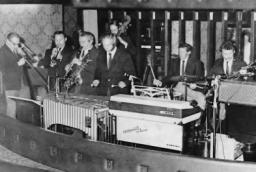
The East Coast Jazzmen continued to be a fixture at Dundee events during the 1970. The Lord Provost’s Ball at the Angus Hotel, Company Dinner Dances, supporting visiting bands at the Caird Hall and countless weddings at the Invercarse Hotel provided regular work for the band. Being a 7 or 8 piece band meant that we were not a cheap band to hire. However we were able to play for all types of dances and could cope with the obligatory Scottish Country dances required at large functions. This compared favourably with the fee of several thousand pounds being charged by agencies for, often very raw, 4 piece rock bands that they had on their books.
The drink driving laws were not yet in place: this allowed both the customers and the band to enjoy freedoms that disappeared in the 1980s. Some of the band, including myself, did not drink and play. Others in the band, however, made up for us. I do remember playing at Bett the Builder’s Annual Dance. The band was given a free bar. One of the directors at Bett Brothers AGM, when looking at the firm’s accounts, wanted to know why the Band’s bar bill exceeded their fee. The Band also played the Christmas dance for the US Air Base in Edzell. We played on two consecutive Fridays thus allowing half of the camp to attend each dance. This was in 1972. I drove up with Harry, his drums in the car beside my double bass. In the backseat were Dave Fimister the trumpet player and Jimmy Wallace with his trombone. We approached a 6 foot 4 marine with a crew cut and Desperate Dan jaw at the sentry box entry. I wound down the window and was about to respond to his question “Who are you?” when Dave helpfully piped up from the back, “We are the Vietcong”
As we stood with our hands on the car and our feet apart as everything in the car was taken out and examined, the joke seemed less funny. After our half hour delay at the gate we got in to the base, set up and started the evening. American air bases are designed to be part of America. They have American food and supplies and the currency is, of course, the dollar. Hence on the base, no drinks or food can be bought by the visitor, without dollars. To allow the band members to have a drink during the evening we were all given two small blue tickets. These could be exchanged at the bar for the drink of our choice. A very civilized system.
The following Friday we arrived at the base to play the second half of the gig. We got onto the base safely with Dave under pain of death to say nothing at the gate and set up to play the evening. After the first number I noticed Jimmy the trombone player, holding a full pint glass. “I didn’t think they had pints of beer at the bar” I enquired. “Its whisky” Jimmy confided and pulled a large roll of cloakroom tickets out of his pocket. He had taken the trouble to go down to Winters the printer in Dundee and purchase a roll of cloakroom tickets to match those given to the band. Jimmy was very pleased with himself, very happy, very drunk, then very passed out in very quick succession. After the first hour he spent the rest of the night asleep in my car.
Jimmy’s life revolved around playing in the band and drinking at the Ladywell Tavern, at the “fit o’the Hill”. Life was straightforward for Jimmy, drink, play and look after his mother with whom he lived. He had a bridge fitted to his teeth to ensure that he could play trombone. Brass players need their teeth to form the embouchure which allows them to play. One Sunday Jimmy’s bridge broke. This was a problem in that he could no longer play. Undeterred Jimmy got the “arldite” glue out, glued his bridge together again and popped it in his mouth. All was well and he played and sang through the Sunday night Supper Dance at the Invercarse without difficulty. On Monday he was taken to Ninewells Hospital where he stayed for a few days as they surgically removed his bridge from his mouth.
The base for the East Coast Jazzmen continued to be the Invercarse Hotel throughout the 70s. Les acquired a set of vibes and began to feature them in the band. This led to him bringing in a pianist to the band. Norrie Whitelaw played for some time. Norrie was a stalwart of the Dundee music scene. He played well and had only one flaw. The perennial musicians curse: he depended on alcohol to function. Norrie took his drinking seriously. Often people came up to buy the band a drink. As someone who did not drink and play I asked for either nothing or an orange juice. At the interval Norrie took me to one side to tell me that I must never do that again. I must order a whisky and he would personally buy me an orange. In the main the East Coast Jazzmen were united in their love of music. They enjoyed playing together and had that satisfaction when a team effort goes well. Norrie was different in that playing was an opportunity to feed his drink habit. One night at the Invercarse we were sitting during the interval chatting when one of us said to Norrie who was nursing the remains of a pint, “drink up Norrie we should go on now.” Nah, he replied carrying his almost empty glass and placing it conspicuously on the piano: “it pays to advertise.”
The band stayed fairly constant during the 70’s and into the 80’s. The rhythm section of Harry on drums, Brian Rose on Guitar and me on Bass formed a fairly tight unit that propelled the band through dance music, some pop music, Scottish country dance and traditional jazz. Brian Rose had joined the band in the middle 60s. He was an accomplished guitar player and an excellent singer. The style of jazz most members of the band favoured was a “Chicago style” traditional. This is best described as having a Count Basie rhythm sound behind a loose but driving front line. This sound meant that the band could quickly assimilate new tunes into the repertoire as long as Dave, on trumpet, played the melodic lead and we all knew the chords. For more organised tunes such as the popular tunes of the day, we learned arrangements that had to be written and worked at. It would be fair to say that there was a significant resistance to learning such arrangements from the front line. Rehearsals were seen as ways of getting the band to play such arrangements, so became very unpopular. It is hard to know if laziness, or musical conviction as to what should be played, lay at the heart of this debate. But the anti- rehearsal bug has bedevilled the band since the late 70’s.
In the late 70’s Les decided to play vibes more regularly in the band and he recruited Gerry Culley to play piano. Gerry was a very talented player with a national reputation. Jazz guests from London or the USA wanted Gerry to accompany them. This meant that Harry myself and Gerry played for a variety of interesting guests in the Rep, Hospitalfield Jazz Club and the Invercarse.
During the 80s there were a number of significant moves in band membership. Firstly Frank Rossiter became the trombone player. Frank is a talented musician who learned his trade in brass bands but was always interested in jazz. He played and toured with the Danny Wilson band who had the hit single “Mary’s Prayer”. He played with almost everyone in the Pop and Jazz scene in Dundee. He is a physics teacher and like almost all others in the East Coast Jazzmen, balanced a career and gigs.
Les, in 1990 retired as environmental health officer for Tayside, and moved back to the family home in Nairn. The band played a number of gigs up north at the Nairn Jazz Festival and at Skibo Castle but because many of the band had careers around Dundee such gigs were difficult.
The East Coast Jazzmen into the 90s
It was at this point that Iain Mathieson joined the band on piano. Iain and I had grown up in Ayrshire and had been playing together since 1957. Iain had joined me in the Chalet Band in 1963 and had moved to Dundee. Iain’s degree from Glasgow University was in Music and English. He chose to pursue a career in teaching English and kept music as a part time interest. He was, and is, a first class musician who swings in almost every genre of music and he brought this talent to the East Coast Jazzmen.
Walter Smith played clarinet in the band while also playing in Havana Swing. Thus there was always a band to call on when jobs appeared. Early in the 90’s Peter Lloyd and his wife Lizzie moved from London to Blairgowrie. Peter had been a professional musician in London while Lizzie had been lead soprano with the BBC Northern Singers. Peter retired to a smallholding in Blairgowrie and joined the musical community in the area. He played all reeds and was an excellent and experienced clarinet player. He was keen to play with the East Coast Jazzmen and so the current front line was formed. The band could, once again, play all the old standards like High Society as well as mainstream tunes requiring a tenor.

The East Coast Jazzmen at the Yacht Club
Ron Elder, Brian Rose, Frank Rossiter, Dave Fimister, Peter Lloyd.
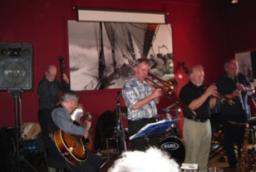
Gigs were not pursued vigorously but were enjoyed when they appeared. The band was playing about once a month: enough to keep them going. This state of affairs went on for about ten years. Harry and I spoke at length about how to revitalise the band and I began to look for some work and purpose for them. Sadly it was at this point that Harry became ill and died thus removing the founding drummer and heartbeat of the band.
Allan Oliphant joined the band on drums for a time and we took a regular gig at the Dalmore Inn in Blairgowrie. As with the Invercarse, having a residency led to other jobs appearing. We played in Rosemount Golf Club, an excellent annual garden party and other Blairgowrie venues.
For thirty years the East Coast Jazzmen had played mainly for dancing. This meant that the only announcements required were, to introduce the next dance as a quickstep, waltz or samba. There was time to agree the next tune while the crowd returned to their seats. In the 90s things changed in that most gigs were of a concert format. This required a different presentation. Debating what to play between tunes was no longer reasonable. It was agreed that I would take over the organisation of the programme for the band and professionalise the presentation. A written programme was now produced, if not agreed, for every gig. Tunes were announced with fights over the key to play in being minimised if not yet eliminated.

The Band at The Dalmore Inn, Blairgowrie 2015
Allan Oliphant on drums
A New Regular Venue
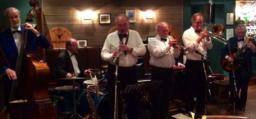
The first thing to be done was to find the band a regular playing venue. Having looked at a few venues we finally settled on the Function Room of The Post Office Bar. A monthly Jazz Club was established on the 2nd Wednesday of every month. The function room held around 60, had a small bar and was a good size for the club. In March 2012 the Broughty Ferry Jazz Club was established and about 25 people found their way to the Post Office Bar. Over the first few months the audience varied between 20 and 40 on Jazz Club nights. The Post Office Bar became a Jazz Venue for the Annual Dundee Jazz Festival. Additionally we were able to feature some concert evenings with friends of the band such as the great guitarist, Jim Mullen and, of course, Molly Duncan and Roger Ball: the Dundee Horns from the AWB. These evenings were a complete sell-out. All was going well, we were building an audience and keeping match fit for other jobs that appeared.
A steady following was built up and new tunes were almost rehearsed. We did manage to master a few new tunes and regular playing made the band sound more cohesive.
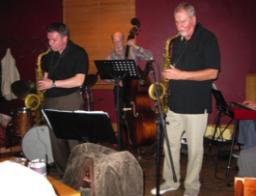
Roger Ball and Molly Duncan
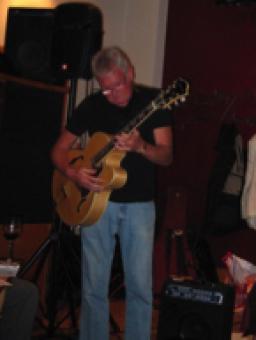
Jim Mullen
Keeping Jazz alive in Dundee
The Post Office Bar was well established and ran every month for many years. The Jazz Club was not unfortunately a high priority for the Post Office Bar and as a consequence we had to close for the winter season when Christmas and New Year parties took precedence over the Club. Hence we tended to end the season with the November Jazz Club and begin again in March.
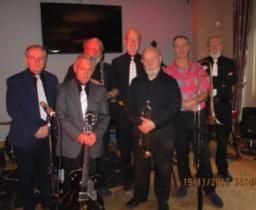
East coast Jazzmen at the Post Office Bar 2014
Happy 60th Birthday for the East Coast Jazzmen
On November the 13th 2018 we decided to celebrate the 60th anniversary of the formation of the East Coast Jazzmen. A 60th birthday concert was arranged and names from the past were invited to attend. Andy Lothian came along and spoke of forming the band and taking it to the Scottish Jazz Band Championships in 1959. People who had played in the band on occasions over the years all turned up and had a “blow”. Tickets were printed and sold out almost immediately. One small difficulty caused me an enormous headache. I set up the room in the afternoon and then arrived at 6.30 in the evening to get everything in place for a 7. 30 start to find that the doors had been opened and there were about 40 people in the hall already. Meanwhile there was an enormous queue of people forming at the door. It was impossible to tell how many in the room had paid and difficult to turn away people who had already purchased tickets. Eventually about 120 people crammed into the hall. The evening was a great success but I never quite recovered from the shambles inflicted on me by the early door opener.
The other interesting thing following on from this evening was an email from the organiser of the Dundee Jazz Festival complaining bitterly that this event had been held on the week of the Jazz Festival. My reply that we had held ourselves ready to play in the festival as normal but once again no contact was made. The 13th of November was our regular Jazz Club Night and was the last of the 2018 season. I suggested, however, for 2019 I would be happy to ensure that the band were available to play in the Festival and would keep the week of the Jazz Festival clear. Surprise, surprise, despite regular correspondence with the organiser, they were unable to fit us into their programme for 2019!
On Monday the 6th of July 2019 the Manager of the Post Office Bar informed me that it had been decided to change the Function Suite upstairs into a games room. This would bring an end to the Jazz Club. Wednesday the 9th of July 2019 would be the last to be held. An era had somewhat abruptly come to an end.
Why is the Band Sitting Now?
On 30th of December 2018 Jock Stout organised a Jazz day at the Yacht Club in aid of the Broughty Ferry Life Boat. Havana Swing, The East Coast Jazzmen and some young local musicians all featured in an afternoon of jazz. The afternoon was brought to a close with a set from The East Coast Jazzmen. During the last number one of the front line lost his balance and fell into the rhythm section. We finished the tune and brought the concert to an interesting and novel close.
At the next Jazz Club at the Post Office Bar it was decided that the front line should play sitting down to avoid more excitement. That was the gig that led us to become Dundee’s Preservation Hall Jazz Band.
The Forthill Sports Club
Having spent a couple of weeks gathering my thoughts and sounding out key members of the band, I began to explore other venues for the Jazz Club. I went round every restaurant and pub in Broughty Ferry that had a fairly suitable space and offered them the opportunity to host the Jazz Club once a month. One or two showed polite interest but did not take it any further. A couple of venues were keen until it became obvious that the $$ they had in their eyes were not going to be realised.
The Forthill Sports Club had all the facilities the Jazz Club needed and the management saw the potential benefit of having the East Coast Jazzmen playing there once a month. The new venue provided comfortable tables, a bar and space for dancing. The loyal crowd enjoyed the new facilities and an audience of around 50 became a regular attendance.
The band was refreshed by two new members.
Laurie Palmer had retired to Edinburgh and was playing drums again in the East of Scotland. Many of the band had played with Laurie in Dundee in the early 60’s. Laurie graduated in 1965 and spent his summer as a roadie for Kenny Ball before taking up his career as an engineer. He was keen to join up with the East Coast Jazzmen again and so in 2019 became the drummer in the Band.
Sheila Gaughan joined the band as a vocalist. Sheila had been singing in various Dundee bands since 2004. She very quickly fitted into the band’s repertoire and also brought her own rendition of the “Great American Song Book”. It is hardly surprising that she fitted in so well as she is the daughter of Andy and Sheila Lothian: Andy, the founder of the East Coast Jazzmen, and Sheila, the band’s first singer.
The Forthill Sports Club functioned well as the monthly Jazz Club and did not have to close over the Christmas and New Year period. Even in poor winter weather the Club was well attended. Some dance space was created and while only a few couples felt inspired to dance, it did add another dimension to the Jazz Club.
Guests appeared from far and near and some thought had to be given as to when they would sit in with the band. I tried to ensure that the first half was an organised programme featuring the resident band that people had come to hear. During the second half we managed to fit in some excellent musicians who added to the entertainment. Bob Ross played regularly on clarinet as did Nigel Porteous on banjo and Walter Smith on clarinet. Joe McKay appeared with banjo on occasions while Paul Greenwood lifted the band often with his excellent alto and flute playing.

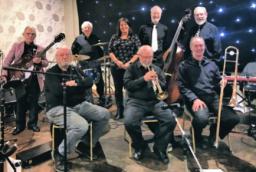
The East Coast Jazzmen at the Forthill Sports Club 2019
Brian Rose, Peter Lloyd, Laurie Palmer, Sheila Gaughan, Dave Fimister, Ron Elder, Frank Rossiter, Iain Mathieson.
Suddenly it all stops
The March the 11th Jazz Club was held, but already the seeds of difficulty were becoming evident. In discussion with a number of regulars it was suggested that those concerned about corona virus, who had any underlying health difficulties, should not attend. The Club was held with around 30 in attendance. This was at least 20 below the expected number. A few days later the World locked down and the Jazz Club came to a shuddering halt. We must wait and see what happens in the future but it does not look as though the Club can open anytime soon. The demographic of the audience and the band both mitigate against any easing of the lockdown allowing such a gathering. Time will tell.
The Band survived National Service, so I feel sure Corona Virus can be beaten! Instruments are being practised in the seclusion of the homes of the East Coast Jazzmen. When we settle on a key and a date, we will be back.
Former Leaders of the East Coast Jazzmen
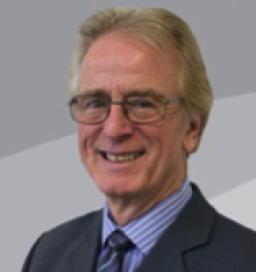

Andy Lothian was the man who started the East Coast Jazzmen when he was 18. He formed the band and pursued its success with his characteristic entrepreneurial energy and enthusiasm. Uniforms, arrangements and the, all important, van, were all down to Andy’s drive. Eventually in 1961 Andy realised that he had to make a living and bass playing in the band was not going to do it, so he started his Music Agency. This business grew, developed and transformed over the years to become Insights, which is now a very successful large multinational company. Andy still enjoys sitting in with the band occasionally.

Les Cameron was responsible for bringing the East Coast Jazzmen together again in 1964. Les played piano, accordion and then vibes. He wrote many of the arrangements for the band in the 70’s and 80’s. When Les began to play vibes this meant that other piano players joined the band for a time. This brought Norrie Whitelaw into the band and then Gerry Cully played for a few years. Iain Mathieson became a regular player with the band. This meant that two of Scotlands foremost piano players were regularly to be heard playing with the band. Interestingly both Gerry and Iain also played trombone.
Sadly Les died in Inverness in 2019. He played often at Skibo Caslte until his unfortunate demise.

The Band into the 21st Century
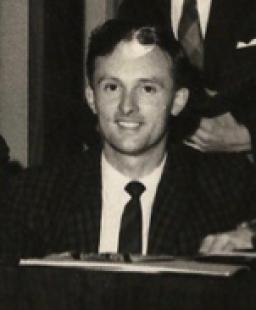
Dave Fimister was the founding trumpet player and has occupied the chair ever since. Dave has an unrivalled in-depth knowledge of traditional and mainstream jazz. He is a keen listener to classical music and particularly enjoys Wagner. Dave has a fairly unique sound but is probably most like Ruby Braff and Mugsy Spanier in style. If Dave swings –the Band swings.
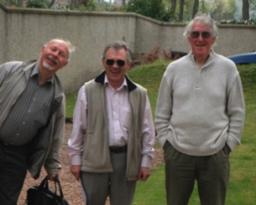
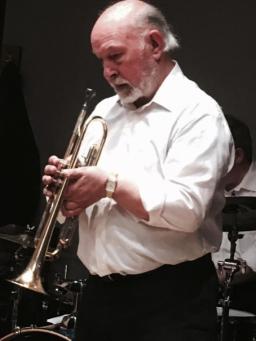
Dave, Brian, Harry at the Jazz Festival at Nairn
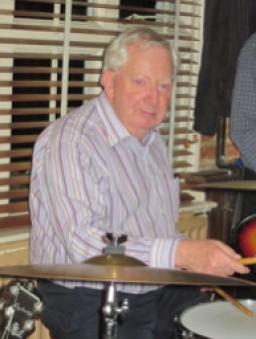
Harry Morrison was the drummer until his untimely death in 2010. Harry was the heartbeat of the band. He was steeped in the jazz of the 20’s to the 60’s Harry’s sense of humour carried him through all difficult situations in the band and in life.
Laurie Palmer

Laurie Palmer became the drummer in the band in 2019. Laurie has played extensively as a jazz drummer throughout his travels as an engineer. On his return to Edinburgh he renewed his Dundee connections and joined the band. Laurie knows all the tunes, all the arrangements and brings an infectious enthusiasm to the rhythm section.
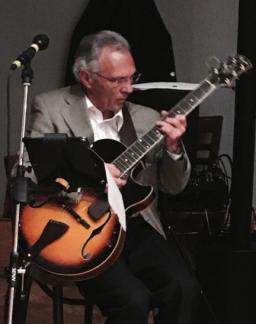
Brian Rose

Brian Rose became the guitarist and vocalist in the band in the mid 60’s. Brian had played in several pop groups around Dundee and had developed into an excellent singer of all genres of music from Nat King Cole to Stevie Wonder. He brought an authentic Chicago style chord backing to the band that gave a Basie style sound rhythm section.

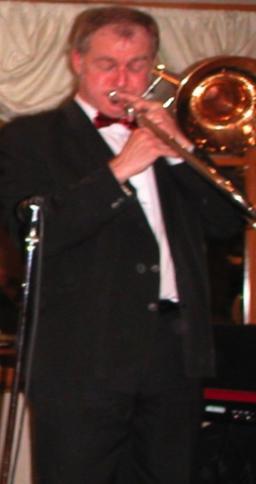
Frank Rossiter took over the trombone chair from Jimmy Wallace in the 80’s. Frank brought enthusiasm and great skill to the band. This has continued ever since. The band always raises its game when Frank is playing. Frank had played and toured with some first rate bands over the years. Danny Wilson was probably the best known of these. Frank sings, plays a mean mouthorgan and plays all styles of jazz well.

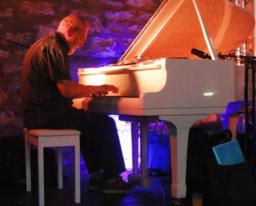
Iain Mathieson became the resident piano player in the band in the 90s. He is classically trained and brings a wide experience of all types of jazz to the band. Iain is in great demand by vising artists and is currently playing keyboards with Spatz & Co: a collection of the 10 best jazz musicians in Scotland who perform in theatres throughout the country to sell out crowds. Iain is a gifted arranger and has excelled in all genres of music.

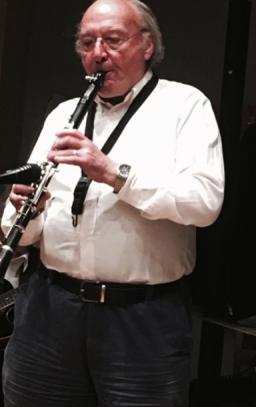
Peter Lloyd migrated up to Blairgowrie having been a professional musician in London for many years. He played in a couple of the big bands in the area and fitted well into the East Coast Jazzmen as a proficient and experienced clarinettist and tenor player. Peter has played in all kinds of band for the last fifty years. From Woody Herman deps to playing with Sandy Brown, Peter has been there and done it.

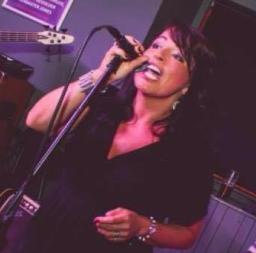
Sheila Gaughan joined the band in 2019. She brings a stage presence and range of songs to the band that adds variety and depth to the programme. She is the daughter of first singer in the band, Sheila Lothian. Sheila is an accomplished violinist and vocalist. She has sung in a number of bands ranging from an acoustic three piece, a 9piece with full brass section to The Woodlands Dance Orchestra. This wide experience and feel for jazz adds to the performance of the East Coast Jazzmen. A new chapter has begun for the band with an excellent female vocalist.
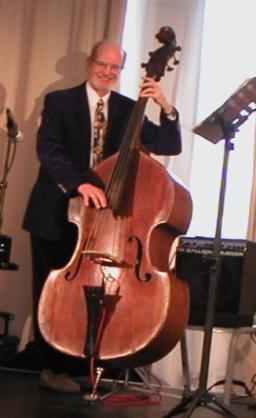
Ron Elder
Ron joined the reformed East Coast Jazzmen in 1964 and has been with them ever since. Having played bass in traditional bands in Glasgow, he moved to Dundee in 1962. Over the years he combined his playing with the East Coast Jazzmen, with other bands ranging from Warren Vache and Jimmy Deuchar to Bob Wilbur and Havana Swing. The 'Funk' years of the 70's led him to doubling up on bass guitar, though he plays the Double Bass now. Introducing the band and manoeuvering through the bands likes and dislikes, take up much of his time.

The East Coast Band through the years.
Over the last 60 years the personnel of the band has changed. To document the changes I have organised this presentation by instrument. The dates given are approximate. These are the musicians who were in the band for a period of time. Others such as Fiona Duncan (vocals) and George Kidd ( trombone) may have played on occasions or sat in with the band, but the names given are those who were with the band for a considerable period.
Trumpet. Clarinet
Trombone Banjo/ Guitar Drums
Dave Fimister 1958 – present
Andy Tully (1958 – 1965) Doug Gow (1965 – 1986) Walter Smith(1985 – 1990)
Peter Lloyd (1990 – present
Walter Fisher (1958 – 1961) Jimmy Wallace (1964 – 1986 )
Frank Rossiter (1986 – present
Watson Laing (1958 – 1961) Dave Moodie (1964 – 1965 )
Brian Rose (1965 – present
Harry Morrison (1958 – 1966 ) Brian Henderson(1966 – 1968) Harry Morrison (1968 – 20010 ) Allan Oliphant (2012 – (2018 ) Laurie Palmer ( 2019 – present
Piano/ vibes/accordion Les Cameron ( 1964 – 1990 )
Piano Bass Vocalists
Norrie Whitelaw (19773 – 1978 )Gerry Cully (1980 – 1992 )
Iain Mathieson (1992 – present
Andy Lothian ( 1958 – 1961)
Ron Elder 1964 – present
Bonnie Lee (1958) Sheila Mitchell (1958 – 1961)
George Cabrelli (1967 – 1977 ) Marlyn Smith ( 1980 – 1986 ) Brian Rose ( 1965 – present
Sheila Gaughan ( 2019 - present